Monteverde Cloud Forest, Costa Rica: A Visitor's Guide to Life Above the Canopy
By The Costa Rica List Editorial — Sun May 24 2026
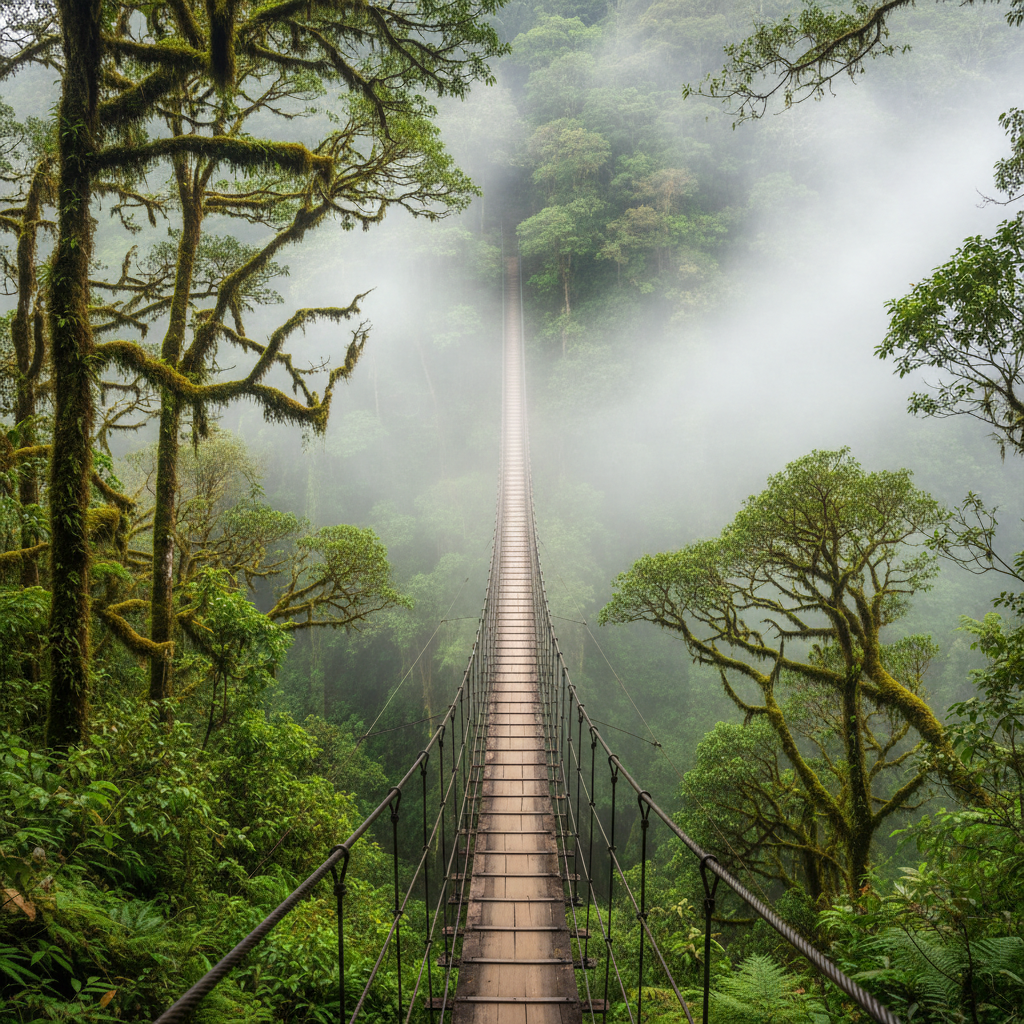
Explore Monteverde, Costa Rica's premier cloud forest. Discover its biodiversity, the Quaker history of conservation & the unique flora of this misty highland.
The Monteverde Cloud Forest is Costa Rica's most famous stretch of high-altitude rainforest — a permanently mist-wrapped ecosystem straddling the continental divide in the Tilarán Mountain Range, about 3.5 hours northwest of San José. Unlike lowland rainforests that drink from heavy rainfall, a cloud forest lives inside the clouds themselves: trade winds off the Caribbean condense against the mountains, bathing the canopy in near-constant fog. The result is one of the most biodiverse places on Earth — home to the Resplendent Quetzal, more than 400 bird species, and the highest concentration of orchids on the planet. This guide covers how to visit Monteverde: which of the three cloud forest reserves to choose, when to go, what it costs, how to get there, and the remarkable Quaker conservation story behind it all.
The Science Behind the Mist
What makes Monteverde distinct from the tropical dry forests of Guanacaste or the lowland jungles of Manuel Antonio is its specific microclimate. As moist air is pushed up the mountain slopes, it cools and condenses, forming a consistent layer of fog and mist. This "horizontal precipitation" provides a steady supply of moisture to the plants, even during the dry season. This unique weather pattern supports a staggering amount of flora; it is estimated that over 3,000 species of plants reside here, including the highest concentration of orchids on the planet.
Walking through the forest, the visual density is overwhelming. Every square inch of the giant hardwood trees is covered in "epiphytes"—plants like mosses, ferns, bromeliads, and orchids that grow on other plants rather than in the soil. These hanging gardens create a complex vertical ecosystem that allows creatures to live their entire lives hundreds of feet above the forest floor without ever touching the ground.
The numbers behind Monteverde's reputation are extraordinary for its size: the Monteverde Cloud Forest Biological Reserve protects roughly 10,500 hectares (about 26,000 acres) spanning both Caribbean and Pacific slopes of the continental divide, and the broader Monteverde zone is frequently credited by biologists with harboring a meaningful share of Costa Rica's total biodiversity — a country that itself holds around 5–6% of the world's species, according to Costa Rica's National System of Conservation Areas (SINAC).
How to Get to Monteverde
Monteverde's remoteness is part of its protection — but the journey is far easier than its reputation suggests, since Route 606, the final mountain climb, was fully paved in 2021.
- From San José: ~3–3.5 hours by car via Route 1 and Route 606; shared shuttles run ~US$55–65 per person; the public bus takes ~4.5–5 hours.
- From La Fortuna / Arenal: The jeep-boat-jeep transfer (van–boat–van across Lake Arenal) takes about 3 hours and costs roughly US$30–40 — faster and far more scenic than the 4-hour drive around the lake. New to the region? Start with our guide to La Fortuna and Arenal.
- From Liberia (LIR): ~2.5 hours by car, making Monteverde an easy first stop after landing in Guanacaste.
- Base town: All visitors stay in or around Santa Elena, the commercial hub 15 minutes below the reserve entrance.
Best Time to Visit Monteverde
The dry season runs December through April, with the clearest trails and most reliable canopy views — though December and January bring strong trade winds and horizontal mist (bring a windproof layer). For birdwatchers, February through May is prime: it overlaps the Resplendent Quetzal's breeding season (March–July), when sightings near wild avocado trees are most likely. The green season (May–November) means afternoon rain but a quieter, greener forest and better prices. Monteverde is worth visiting in any month — the mist is the point, not the obstacle.
A Sanctuary for the Resplendent Quetzal
For birdwatchers, Monteverde is synonymous with the Resplendent Quetzal. Once considered sacred by the Maya and Aztecs, this emerald-green bird with its long, flowing tail feathers is the "holy grail" of Central American avian life. While elusive in other regions, the high-altitude cloud forests of Monteverde provide the perfect nesting grounds, particularly during the breeding season between March and July when they feed on the fruit of the wild avocado tree.
Beyond the Quetzal, the region is home to the Three-wattled Bellbird, known for its distinctive metallic "bonk" sound that echoes through the canopy. The biodiversity statistics are staggering: Monteverde hosts over 400 species of birds, 100 species of mammals, and thousands of insect species. It is also one of the few places where you might catch a glimpse of the elusive oncilla (a small spotted cat) or the endangered Baird's Tapir.
The Quaker Legacy and Conservation History
The story of Monteverde's preservation is as much about human history as it is about biology. In the early 1950s, a group of Quaker families from the United States migrated to the region, seeking a peaceful life away from the military draft. They began dairy farming—producing the now-famous Monteverde cheese—but they also recognized the necessity of protecting the water source for their valley. They set aside a significant portion of the primary forest, which eventually became the nucleus of the Monteverde Cloud Forest Biological Reserve. The reserve's founding is well documented: in 1972, scientist George Powell and Quaker settler Wilford Guindon worked with the Tropical Science Center to establish the original protected area, which grew from roughly 328 hectares into today's reserve. That partnership between foreign researchers and the local community remains the template Costa Rica's tourism board (ICT) points to when promoting the country's community-based conservation model.
This early grassroots conservation effort evolved into a global model. Today, the region is a patchwork of protected areas, including the Monteverde Cloud Forest Reserve, the Santa Elena Cloud Forest Reserve, and the Children's Eternal Rainforest (the largest private reserve in Costa Rica, funded by donations from children around the world). This community-led approach has allowed Monteverde to resist the over-development seen in other tourist hubs, maintaining a rustic, educational atmosphere.
Monteverde's Three Reserves Compared
| Monteverde Cloud Forest Reserve | Santa Elena Cloud Forest Reserve | Curi-Cancha Reserve | |
|---|---|---|---|
| Character | The original and most famous (est. 1972) | Community-run, higher elevation, quieter | Private, mixed forest and open habitat |
| Best for | First-time visitors, classic cloud forest | Escaping crowds, misty atmosphere | Birdwatching and quetzal sightings |
| Trails | ~13 km of well-maintained trails | ~12 km, generally quieter | Open, light-filled paths |
| Approx. entrance | ~US$25 adults | ~US$18 adults | ~US$25 adults (daily visitor cap) |
Also worth knowing: the Children's Eternal Rainforest (Bosque Eterno de los Niños), Costa Rica's largest private reserve at over 23,000 hectares, funded by children's donations from around the world — its Bajo del Tigre trail is open to visitors.
How Much Does Monteverde Cost?
Typical 2026 visitor prices (approximate, per adult): reserve entrance US$18–25; guided reserve walk US$25–40 extra (worth it — guides spot ten times what you will); hanging bridges US$35–45; zip-line canopy tour US$50–85; night tour US$25–35; coffee/chocolate tour US$30–45; meal in Santa Elena US$8–15; mid-range hotel double US$70–140 per night. A mid-range couple should budget US$140–220 per day.
Where to Stay in Monteverde
- Santa Elena town: Walkable to restaurants, cafés, and bus stops — best for budget travelers and those without a car.
- Cerro Plano: The middle ground between town and reserve, with many mid-range lodges and easy tour pickups.
- Monteverde village (near the reserve): Quiet lodges surrounded by forest, minutes from the reserve gate — best for early-morning birders.
What to Pack for Monteverde
Monteverde surprises visitors: at 1,400–1,600 meters of elevation, daytime temperatures run a cool 13–21°C (55–70°F), and wind-driven mist can soak you in minutes. Pack warm layers, a waterproof (not just water-resistant) jacket, closed shoes with grip for muddy trails, a hat, a dry bag for electronics, and binoculars — the wildlife here lives high in the canopy.
Sustainable Tourism and Adventure
Monteverde has become a premier destination for "soft adventure" and eco-tourism. It was here that the original canopy tours were popularized, allowing visitors to zip-line through the mist or walk across massive hanging bridges. These bridges offer a unique perspective, placing visitors eye-to-eye with the canopy's inhabitants and providing a safe way to observe the fragile ecosystem without disturbing the forest floor.
Night tours have also become a staple of the Monteverde experience. As the sun sets, the cloud forest transforms. Night-active creatures such as sloths, tarantulas, red-eyed tree frogs, and sleeping toucans become the focus, offering a starkly different perspective on the forest's rhythms. Booking through guided tours across Costa Rica is the easiest way to line up a certified naturalist. For those interested in sustainable agriculture, coffee and chocolate tours in the surrounding hills demonstrate how these vital crops can be grown in harmony with the forest through shade-grown techniques.
A Perfect 2-Day Monteverde Itinerary
Day 1 — The classic reserve. Enter the Monteverde Cloud Forest Reserve at opening time with a naturalist guide for the best quetzal odds, walk to the continental divide viewpoint, then spend the afternoon in Santa Elena's cafés. After dark, join a guided night tour for sloths, tarantulas, and red-eyed tree frogs.
Day 2 — Above the canopy. Cross the hanging bridges or ride a zip-line circuit in the morning mist, then finish with a shade-grown coffee and chocolate tour in the surrounding hills — and a stop for the famous Monteverde cheese on the way out.
Wildlife Watching Tips
Hire a certified local guide (their spotting scopes and ears transform the experience), arrive when the reserves open, watch fruiting wild avocado trees for quetzals between February and May, listen for the metallic "bonk" of the Three-wattled Bellbird from March to July, and walk slowly — in a cloud forest, most of the 400+ bird species and 100+ mammal species reveal themselves to the patient, not the fast.
Living in the Clouds: The Expat Perspective
The lifestyle in Monteverde is distinct from the "Pura Vida" beach culture of the coast. Life here is defined by cooler temperatures, wood-burning stoves, and a close-knit community focused on arts, education, and sustainability. The town of Santa Elena serves as the commercial hub, offering organic markets, cozy cafes, and a surprising variety of international cuisine, fueled by the steady stream of researchers and eco-volunteers.
However, living in the cloud forest comes with its challenges. The humidity is constant, requiring specialized home maintenance to prevent mold, and the winding mountain roads can be rugged. Yet, for those who prioritize nature over nightlife, the reward is an unparalleled connection to one of the most fragile and beautiful environments on Earth. Development is strictly monitored, ensuring that the "green lung" of the mountain remains intact for future generations.
The Threat of Climate Change
Despite its protected status, Monteverde faces a significant threat: climate change. As global temperatures rise, the "cloud base" is lifting. The mist that the forest relies on is moving higher up the mountain, potentially leaving the lower sections of the reserve too dry to support cloud forest species. This phenomenon was famously linked to the extinction of the Golden Toad, which was last seen in Monteverde in 1989. Declared extinct by the IUCN in 2004, the Golden Toad is often described as one of the first documented extinctions linked to climate change — a loss that turned this small Costa Rican community into a case study cited in research and policy discussions worldwide. Modern conservation efforts now focus on creating "biological corridors," allowing species to migrate to different altitudes and regions as the climate shifts.
Monteverde FAQ
What is a cloud forest?
A cloud forest is a high-altitude tropical forest that gets much of its moisture directly from low-hanging clouds rather than rainfall. Mist condenses on the vegetation — called horizontal precipitation — keeping the forest wet even in the dry season.
Is Monteverde worth visiting?
Yes. Monteverde is one of the world's most famous cloud forests, offering quetzal sightings, hanging bridges, zip-lines, night tours, and a pioneering conservation story — all within 15 minutes of the town of Santa Elena.
How many days do you need in Monteverde?
Two days is ideal: one for a guided reserve walk and a night tour, one for hanging bridges or zip-lining plus a coffee tour.
Which is better: Monteverde Reserve or Santa Elena Reserve?
The Monteverde Cloud Forest Reserve is the original and most famous, with the best infrastructure. Santa Elena Reserve is quieter, mistier, and community-run. For birdwatching specifically, many guides prefer Curi-Cancha Reserve.
When can you see a quetzal in Monteverde?
The best window is February through May, overlapping the breeding season (March–July), when Resplendent Quetzals feed on wild avocado trees at forest edges. Early morning with a guide gives the best odds.
How cold does Monteverde get?
Cooler than most of Costa Rica: typically 13–21°C (55–70°F) during the day at 1,400–1,600 m elevation, with wind chill and mist. Bring warm layers and a waterproof jacket.
Is the road to Monteverde paved?
Yes. Route 606, the final climb to Santa Elena, was fully paved in 2021. A 4x4 is no longer required to reach Monteverde.
How do you get from La Fortuna to Monteverde?
The jeep-boat-jeep transfer — van to Lake Arenal, boat across, van up to Santa Elena — takes about 3 hours and costs roughly US$30–40. Driving around the lake takes about 4 hours. See our full guide to the wonders of La Fortuna.
How much is the Monteverde Cloud Forest Reserve entrance fee?
About US$25 for adults. A guided walk costs US$25–40 more and dramatically increases wildlife sightings. The quieter Santa Elena Reserve charges about US$18.
Why did Quakers settle in Monteverde?
A group of American Quaker families moved to Monteverde in 1951 seeking a peaceful life. They started dairy farming — creating the famous Monteverde cheese — and protected the forest above their farms to secure their water supply, seeding what became the Monteverde Cloud Forest Biological Reserve in 1972.
Monteverde stands as proof of what a community can build when it values its natural heritage over short-term profit — a farming settlement that chose to protect its watershed and, in doing so, created one of the world's great ecological destinations. Come for the quetzals and the hanging bridges; leave understanding why Costa Rica became the world's conservation benchmark.
Planning your route? Most travelers pair Monteverde with the volcano and hot springs of La Fortuna and Arenal, a three-hour jeep-boat-jeep transfer away. You can also browse canopy and zip-line tours or hotels across Costa Rica to build the rest of the trip.