Costa Rica News Summary — May 2026: Renewable Records, New Roads & Rising Inland Real Estate
By The Costa Rica List Editorial Team — Sat May 23 2026
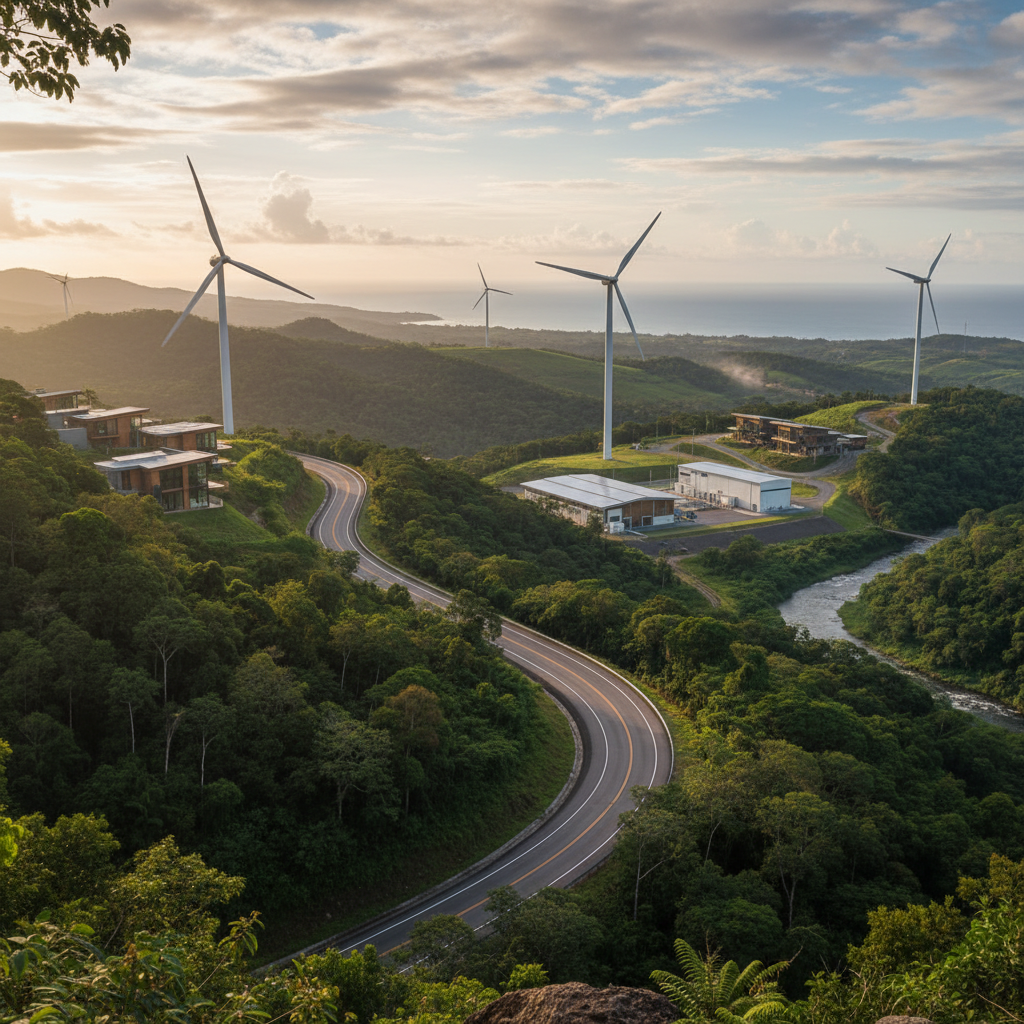
May 2026 in Costa Rica: 99.8% renewable grid, completed Route 27 expansion, new Circular Economy Law, Liberia's Digital Nomad Wing, and an inland real-estate surge in San Isidro de El General and Grecia.
Costa Rica's May 2026 news cycle delivered concrete wins on three fronts: a record 99.8% renewable share on the national power grid, the completed Phase II expansion of Route 27 between San José and the Central Pacific, and a real-estate surge in inland "secondary cities" like San Isidro de El General and Grecia. Add a new Circular Economy Law, a digital-nomad terminal at Liberia's international airport, and 50,000 trees planted on the Osa Peninsula in a single weekend, and May makes a strong case that the country is managing growth without trading away the environmental reputation that drives it. Here is what happened — and what it means if you visit, live, or invest here. May 2026 at a Glance Energy: 99.8% of Costa Rica's grid ran on renewables in the first trimester of 2026; three new Guanacaste solar farms came online in May. Law: New Circular Economy Law passed — stricter corporate waste rules, tax breaks for closed-loop manufacturing. Roads: Route 27 Phase II expansion complete; faster San José → Jacó/Quepos travel. Airports: Liberia (LIR) opened a "Digital Nomad Wing" with fiber workstations and fast-track immigration for Remote Work Visa holders. Real estate: Inland "secondary cities" (San Isidro de El General, Grecia) up ~8% year-over-year. Conservation: 50,000+ native trees planted on the Osa Peninsula in one weekend. Green Energy Milestones and Carbon Neutrality Costa Rica's grid — operated by the state utility Grupo ICE — has exceeded 98% renewable generation almost every year since 2015, drawing primarily on hydroelectric plants like the one at Lake Arenal, geothermal fields on the flanks of Guanacaste's volcanoes, and wind farms around Tilarán. The May 2026 solar expansion addresses the grid's historical weak spot: dry-season months when reservoir levels fall. That context makes this month's figure notable — it was achieved in the driest part of the year. Costa Rica has reached a historic benchmark this month as the government announced that 99.8% of the national power grid was fueled by renewable sources over the first trimester of the year. This achievement comes on the heels of the new Guanacaste Solar Expansion Project , which officially integrated three massive photovoltaic farms into the national grid in early May. Additionally, the Legislative Assembly has passed a new "Circular Economy Law." This legislation mandates stricter waste management protocols for corporations and provides tax incentives for businesses that implement closed-loop manufacturing processes. For the tourism sector, this means a shift toward zero-waste boutique hotels, a trend already seeing high demand in areas like Nosara and Santa Teresa. May 2026 indicator Figure Renewable share of national grid (Q1 2026) 99.8% New solar farms integrated (Guanacaste) 3 Trees planted, Osa Peninsula initiative 50,000+ El General Valley property appreciation (YoY) ~8% Infrastructure Upgrades: Connectivity Beyond the Central Valley Transportation remains a top priority for the current administration. May 2026 marks the completion of the Phase II expansion of Route 27, aimed at easing the bottleneck between San José and the Central Pacific coast. Commuters and weekend travelers are already reporting reduced travel times to regions like Jacó and Quepos. In the north, the Daniel Oduber Quirós International Airport (LIR) in Liberia has inaugurated its new "Digital Nomad Wing." This specialized terminal area offers high-speed fiber optic workstations and streamlined immigration processing for those entering on the updated Remote Work Visa. As Guanacaste continues to attract international talent, these upgrades solidify the region's status as a premier global hub for location-independent professionals. What This Means for Travelers The practical takeaway from May's news is shorter travel times and greener stays. The Route 27 expansion trims the drive from San José to Central Pacific beach towns like Jacó — worth knowing when choosing between flying and driving to the coast. Meanwhile, the Circular Economy Law will accelerate the zero-waste boutique hotel trend already visible in Nosara and Santa Teresa; expect more properties competing on sustainability credentials, not just ocean views. And if you work remotely, Liberia's new Digital Nomad Wing makes Guanacaste the easiest soft landing in Central America. Real Estate Trends: The Rise of the "Secondary Cities" The real estate market in May 2026 shows a fascinating shift in buyer behavior. While coastal properties in the Nicoya Peninsula remain high-value, there is a surge in interest in "Secondary Cities" such as San Isidro de El General and Grecia . Investors are looking for more temperate climates and lower price points, leading to a mini-boom in eco-conscious residential developments in the Southern Zone. Market analysts suggest that the improved internet infrastructure in rural areas has made these once-remote locations viable for long-term living. Property values in the El General Valley have seen a steady 8% year-over-year increase, driven largely by North American and European retirees seeking authentic Tico culture away from the tourist crowds. Figures in this section reflect market-analyst reporting rather than official government statistics; Costa Rica does not publish a national house-price index, which is why serious buyers commission independent valuations. What This Means for Expats and Investors May's real-estate data confirms a structural shift: improved rural internet has unlocked Costa Rica's interior. San Isidro de El General and Grecia offer temperate climates, lower entry prices, and authentic Tico town life — and the ~8% year-over-year appreciation in the El General Valley suggests the market has noticed. Coastal Nicoya remains the premium play, but buyers priced out of the beach towns now have credible alternatives rather than compromises — browse current Costa Rica real estate listings to compare markets. As always, verify title, water availability, and zoning with an independent attorney before committing. Reforestation Push on the Osa Peninsula Community-led conservation reached a new peak this month with the National Reforestation Initiative, which saw over 50,000 native trees planted across the Osa Peninsula in a single weekend. Supported by NGOs and local volunteer groups, the effort aims to strengthen biological corridors for the endangered scarlet macaw and jaguar populations. Guanacaste's Festival Season Returns After a brief hiatus and restructuring, the Fiestas de Santa Cruz have been reimagined for 2026 with a heavy focus on Guanacastecan folklore and traditional gastronomy, attracting a record number of domestic tourists this May. Find upcoming dates on our list of events across Costa Rica . Key Takeaways Costa Rica's grid hit 99.8% renewable in early 2026, reinforced by new Guanacaste solar farms. The new Circular Economy Law pushes corporations — including hotels — toward zero-waste operations. Route 27's completed expansion shortens San José–Pacific coast drives. Liberia airport now has a dedicated Digital Nomad Wing for Remote Work Visa holders. Inland "secondary cities" are 2026's real-estate story, up ~8% year-over-year. Costa Rica News FAQ — May 2026 What percentage of Costa Rica's electricity is renewable? In the first trimester of 2026, 99.8% of Costa Rica's national grid ran on renewable sources — mainly hydro, geothermal, wind, and a growing share of solar following the Guanacaste Solar Expansion Project. Is Costa Rica carbon neutral? Not yet. Costa Rica's electricity grid is nearly 100% renewable, but transport emissions keep the country short of full carbon neutrality, which remains a stated national goal. What is Costa Rica's Circular Economy Law? Legislation passed in May 2026 that mandates stricter corporate waste-management protocols and offers tax incentives to businesses using closed-loop manufacturing processes. What is Route 27 in Costa Rica? Route 27 is the main highway connecting San José to the Pacific coast at Caldera. Its Phase II expansion, completed in May 2026, reduces travel times to beach destinations like Jacó and Quepos. Does Costa Rica have a digital nomad visa? Yes. Costa Rica's Remote Work Visa (Law 10008) allows qualifying remote workers to stay long-term. In May 2026, Liberia's international airport opened a dedicated Digital Nomad Wing with workstations and streamlined immigration. Where are expats buying property in Costa Rica in 2026? Beyond the established coastal markets, buyer interest is surging in "secondary cities" like San Isidro de El General and Grecia, where temperate climates and lower prices meet newly improved internet infrastructure. Is Costa Rica a good place to invest in real estate? Costa Rica offers political stability and steady demand, with inland markets appreciating around 8% year-over-year in 2026. As with any foreign property purchase, work with an independent attorney to verify title, water rights, and zoning. This is general information, not investment advice. What is the green season in Costa Rica? The green season runs roughly May through November, when afternoon rains return, landscapes turn lush, and prices and crowds drop — a favorite period for repeat visitors. What was the National Reforestation Initiative? A community-led effort in May 2026 that planted over 50,000 native trees across the Osa Peninsula in a single weekend to strengthen biological corridors for scarlet macaws and jaguars. Where can I follow Costa Rica news in English? The Costa Rica List publishes a monthly English-language news summary covering energy, infrastructure, real estate, and culture, plus daily picks on Facebook and Instagram. May 2026 closes with Costa Rica doing what it does best: pairing infrastructure spending with environmental ambition. For travelers, that means shorter drives to the Pacific and greener hotels; for expats and investors, it means the map of "where to live" keeps expanding beyond the coasts. We publish this summary every month. Browse the full news archive for previous editions, and follow The Costa Rica List on Facebook and Instagram for daily updates between summaries. Sources National grid figures: Grupo ICE / CENCE public generation reports. Circular Economy Law: Asamblea Legislativa de Costa Rica. Route 27 works: MOPT (Ministry of Public Works and Transportation). Remote Work Visa: Law 10008 and Dirección General de Migración y Extranjería. Real-estate figures as reported by regional market analysts; treat them as indicative rather than official statistics.